AI agents are about to make coordination 1000× more intense.

But today, every interaction works differently. Email works one way. Payments another. Contracts another. APIs another. That was manageable when humans glued everything together. It becomes the bottleneck when agents need to operate across hundreds of relationships at machine speed.

Blue standardizes interactions. One structure. Every relationship. Any participant.

Humans and AI agents coordinating inside one structured interaction block

The problem

Every interaction works differently.

People use contracts, emails, PDFs, signatures, and handshakes. Services use APIs. Users use apps and websites. Money moves through separate financial rails. Each has a different structure, a different trust model, a different source of truth.

With agents

This fragmentation becomes the core bottleneck. Agents could transform coordination — but only if interactions share a common shape.

  • a restaurant managing 3 partnerships could have agents managing 300
  • a freelancer negotiating 5 deals a year could have agents negotiating 500
  • a local operator could coordinate at the scale of a much larger company

The solution: standardize interactions

Instead of treating emails, orders, agreements, payments, and workflows as fundamentally different things, Blue gives them one common structure — making them easier to build, easier to compose, easier to trust, and much easier for agents to understand.

  • easier to build
  • easier to compose
  • easier to trust
  • much easier for agents to understand

To make that possible, interactions cannot all have different shapes.

Mental model

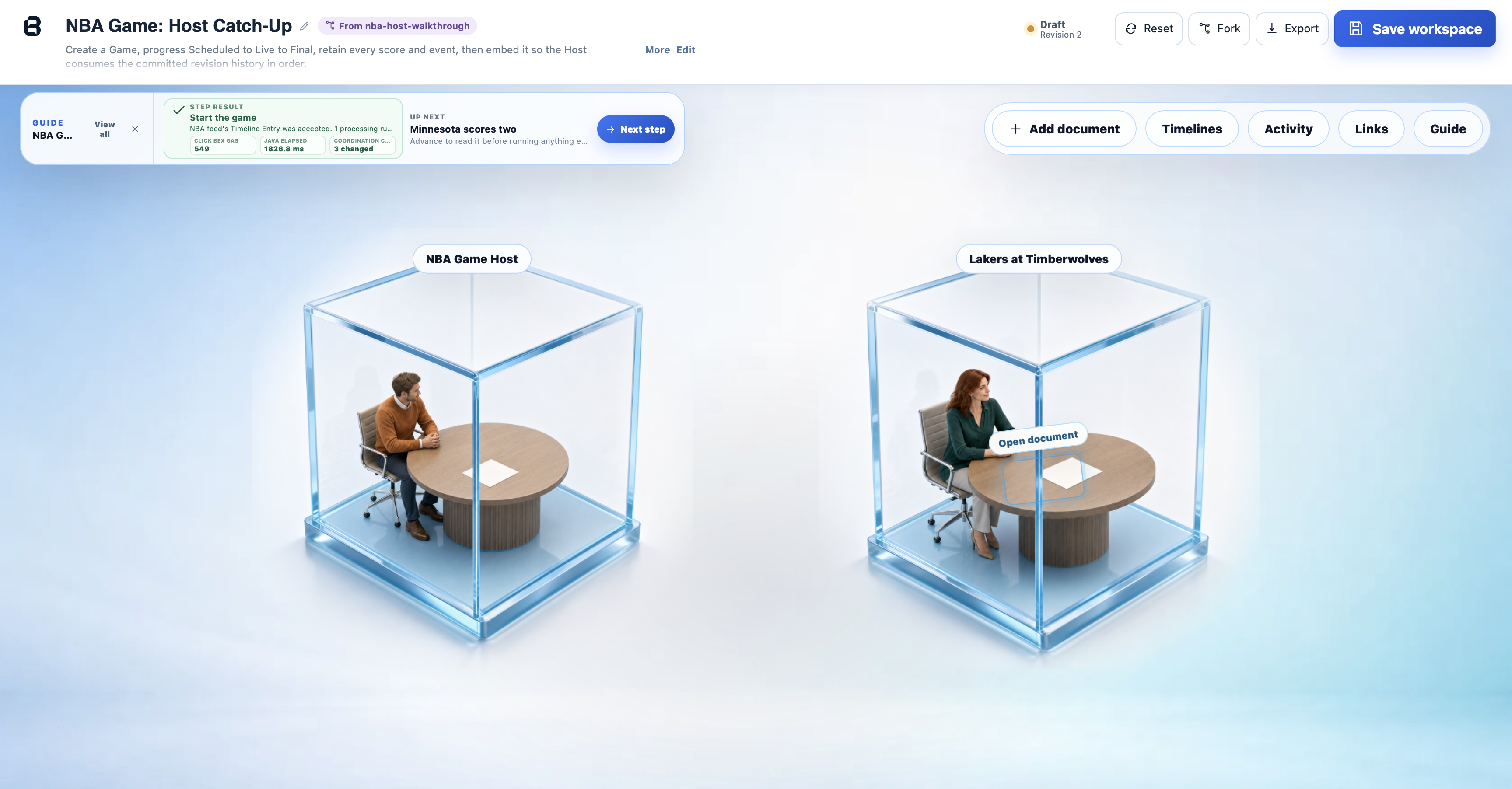
Think in cubes.

One shape for every interaction. Whether an order, a payment, a contract, or a negotiation — it's always the same structure: participants, rules, shared state, verifiable history.

Every interaction is a cube.

Inside: participants — people, agents, services, banks, couriers, legal providers. Everyone has a clear identity others trust. They act according to explicit rules. The state changes when they act. Everything is recorded.

  • participants
  • rules
  • shared state
  • verifiable history

An order is a cube. A payment is a cube. A service workflow is a cube. A negotiation is a cube. Same shape. Different participants. Different rules.

A single shared interaction block with participants around one structured world

Your world is the cubes you're part of.

Alice's world includes: her shop, an automation with her OpenClaw agent, an incoming order where she and her customer participate, a payment for that order with her, the customer, and the customer's bank, a delivery with a courier, a partnership with another business.

Blue does not force everything into one system. It gives every interaction the same shape.
Three separate interaction blocks — Alice managing different parts of her world

Building reality is building blocks.

Once interactions share the same structure, building real processes becomes fast. You don't invent a custom system for each case. You compose blocks: a shop, an order, a payment, a mandate, a delivery, a service agreement. Because they all follow the same pattern, they work together naturally. Not one giant platform — many small blocks that fit together.

A world built from many interconnected interaction blocks

Block

Shop

inventory, offers, policies

Block

Order

buyer, seller, item, terms

Block

Payment

money movement with conditions

Block

Mandate

governs what an agent can do

Block

Delivery

courier proof and completion

Block

Service agreement

external service participates cleanly

How it works

One world, four ways to bring a block to life.

A shop is born from a sentence. A bank secures a payment. A mandate is written in code. An agent acts inside the rules. Same world — built across chat, code, banking, and agent action.

  1. 01

    Alice sets up her shop

    Alice talks to Blink in MyOS and describes her hair-tools business in plain language. Blink turns the description into a real shop, ready to receive orders, partnerships, services, and payment flows.

    She doesn't need to know what Blue is — she just describes what she wants.

    One block, born from a conversation.Block 1 · Shop — Alice's hair-tools store, live and ready to take orders.
  2. 02

    Bob authorizes a payment for his agent at the bank

    Bob wants his agent OpenClaw to make a purchase on his behalf. He asks his bank for an authorization carrying a PayNote — the bank secures the funds, but money only moves if every condition is met.

    • Product Verifier confirms a genuine Dyson Supersonic HD07
    • Shop ships via DHL or UPS with real tracking
    • 2-day review window after delivery
    • If disputed, a return flow kicks in — no blind refund
    One block, secured by a bank.Block 2 · PayNote — governed money OpenClaw can spend, only under Bob's rules.
  3. 03

    Bob writes the mandate for OpenClaw in Node.js

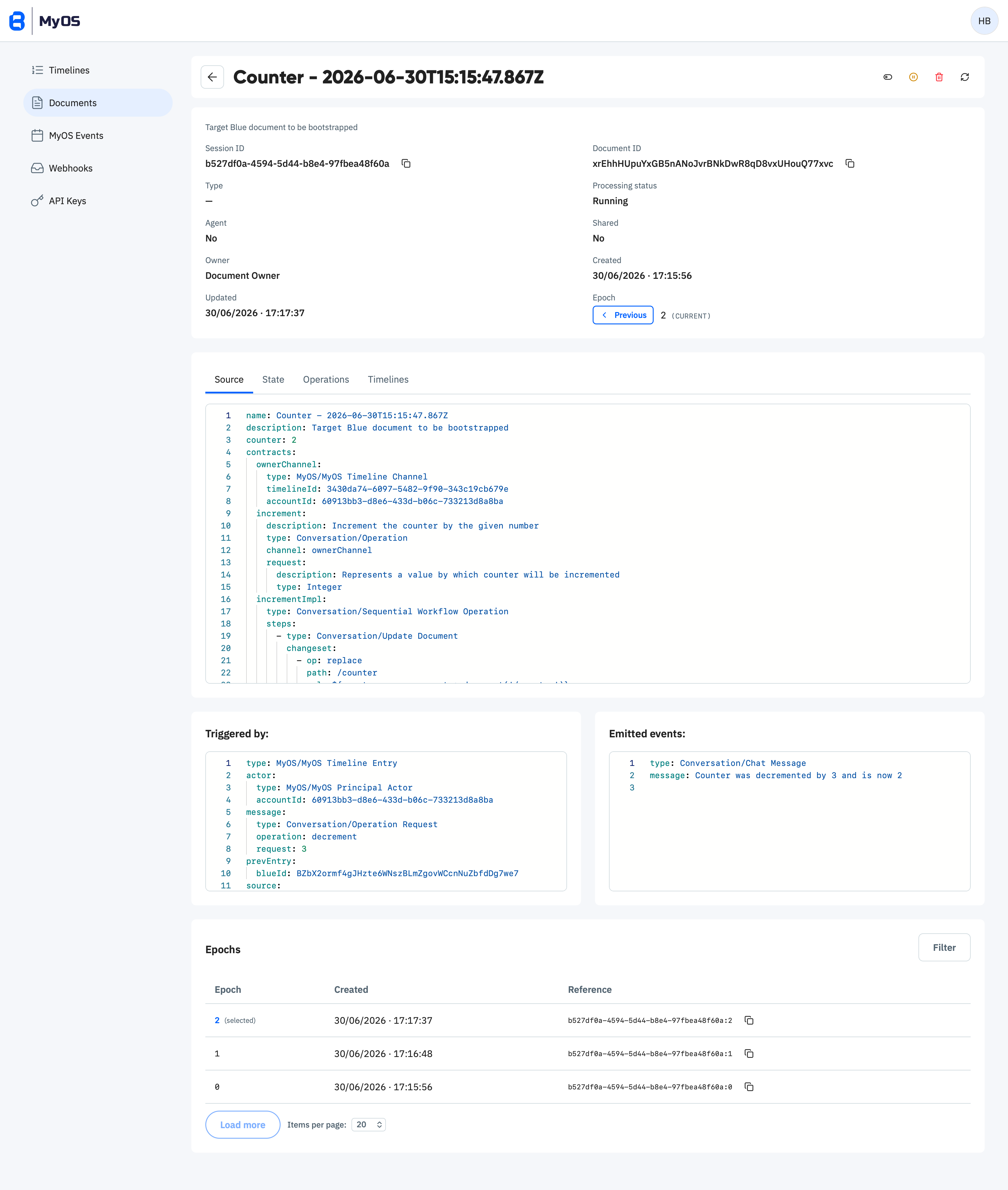
    A short Node.js snippet bootstraps the mandate. It's not a blank check — it's a narrow capability: find a Dyson HD07, stay inside the budget, and only buy through a payment that attaches the required PayNote.

    The rules are made explicit before OpenClaw can act.

    One block, written in code.Block 3 · Mandate — OpenClaw's narrow license to act on Bob's behalf, with the rules in plain sight.
  4. 04

    OpenClaw shops around and buys

    OpenClaw connects to MyOS, reads the mandate, and approaches multiple shops — including Alice's. It compares offers, proves it can pay, and stays inside the PayNote conditions throughout.

    Each merchant conversation is its own order. Some end if terms don't fit. One completes — and only then does money move.

    Many blocks, born from agent action.Blocks 4+ · Orders — OpenClaw's conversations with merchants. Some end. One closes — and that one triggers the PayNote.

Same world. Built through chat, code, bank infrastructure, and agent action.

Why Blue is built for agents

Agents work best when every interaction has the same shape.

Blue gives agents a structured world to act in: verified identity, permanent record, trusted services, structural control, and a shape that scales across all interactions.

01

Verified identity

Agents are not anonymous tool-runners. Every timeline provider attributes agents properly — whether it was a person or an agent, whose authority it used, how it entered the system.

  • person or agent, clearly attributed
  • whose authority it used
  • how it entered the system

02

Permanent record

To do anything, an agent must put an entry on a timeline. Actions are recorded. Attribution is clear. History is permanent and not negotiable later.

  • actions are recorded
  • attribution is clear
  • history is permanent

03

Services, not just skills

For legal review, financial operations, or shipping, agents should use trusted providers who participate in the document and stake their reputation.

  • a lawyer in the cube
  • a bank in the cube
  • not a skill the agent taught itself

04

Structural control

Every step an agent takes is controlled by the document's rules. If the document doesn't allow it, the protocol makes it impossible. Participants can also intervene directly.

  • rules enforced by the protocol, not agent goodwill
  • controllers, auditors, approvers with blocking power
  • oversight is a natural feature, not an afterthought

05

Scalability

Once every interaction follows the same structure, agents can operate across all of them. They only need to understand: participants, rules, state, timelines.

  • one structural model for all interactions
  • no custom setup per domain
  • thousands of agents coordinating across millions of interactions

The stack

Three layers, one family.

Blue is the open language. MyOS makes it practical. PayNotes bring money into the same world without replacing existing rails.

Start here

Move from the mental model into the real protocol.

Start with the tutorial, then go deeper into the language, trust model, and tooling.

Closing

The internet gave everyone communication. AI gives everyone intelligence. Blue gives everyone one structure for interactions — so anything can work with anything, and trust is built into every piece.